
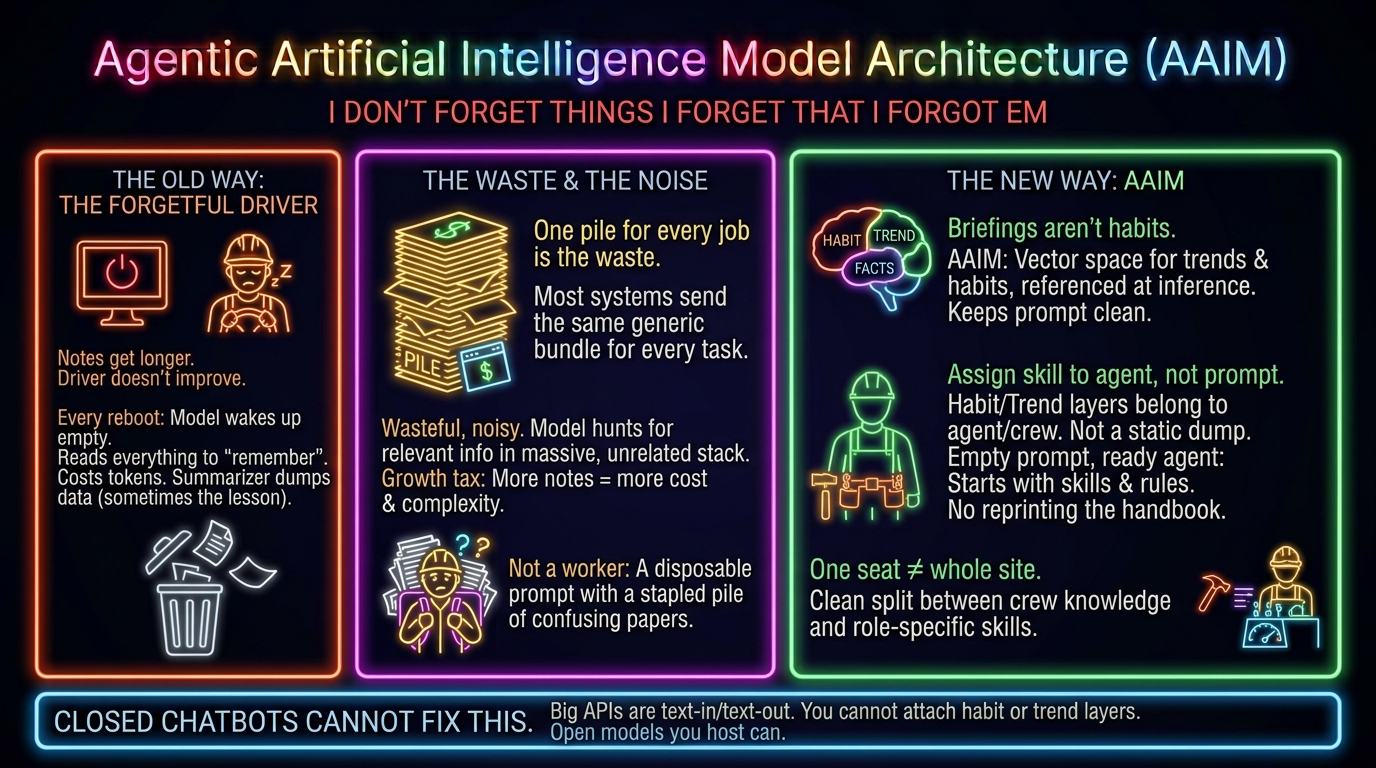
The notes get longer. The driver does not get better.
Every reboot the model wakes up empty. To be itself it must read who it is, what the crew decided, what failed last week. That pile costs tokens. When it does not fit, a summarizer throws pages away — sometimes the lesson.
One pile for every job is the waste
Most systems do this: they build a general context window and a stack of skill files, then send the same bundle no matter the task. The bricklayer gets the crane notes. The reviewer gets last month’s migration diary. Another agent’s leftover “always do X” sits next to today’s ticket.
That burns tokens. It wastes the window. Worse, it adds noise to the signal. The model has to hunt for the three lines that matter inside a stack written for someone else, or for a job that already finished. Growth makes the tax worse: more notes, more cost, more chance the useful line is at the bottom and never loads.
You are not hiring a worker. You are spinning up a disposable prompt thread, then stapling a pile of other people’s paper to its chest and hoping it finds the right page.
A briefing is not a habit
Saving work in a file or a search box is useful. Tomorrow the model is still a stranger who has to read the briefing again, in the same scarce space it needs for the actual job.
If we invent a “habit file” and paste the whole thing into every prompt, we have invented a shorter diary. Same tax. Same noise. AAIM is the opposite: a catalog plus a clerk. The clerk is a meaning matcher. It pulls the two or three standing orders that match this job and leaves the rest on the shelf. Skill files and project memory stay for facts and tickets. The repeated instructions leave the window until they are relevant.
Assign the skill to the agent, not to the prompt
A habit layer belongs to one agent. A trend layer belongs to the crew. Both grow over time. They are not a static dump of everyone else’s notes.
Give that agent a short job. The clerk searches the crew table, then that agent’s table, and attaches only the matching cards. You did not pay to reprint the employee handbook and last quarter’s tickets in English.
That is how people show up. The carpenter does not reread the safety binder and the plumber’s diary before picking up a hammer. They walk in already that worker. Agents can be that, instead of a new thread with a heavier backpack every morning.
One seat is not the whole site
Telling every agent the same safety rules, every morning, is a waste. Telling the bricklayer how to run the crane is also a waste. Today both kinds of knowledge live in the same growing pile. There is no clean split between what the crew shares and what only that role should lean toward.
When one agent finds a better way, the rest do not get it unless someone pastes it into everyone else’s diary — or, worse, into a shared brain with no walls.
Closed chatbots cannot fix this
Big APIs only take text in and send text out. You cannot attach a habit layer or a trend layer to their encoder. Open models you host can. That is the opening.