
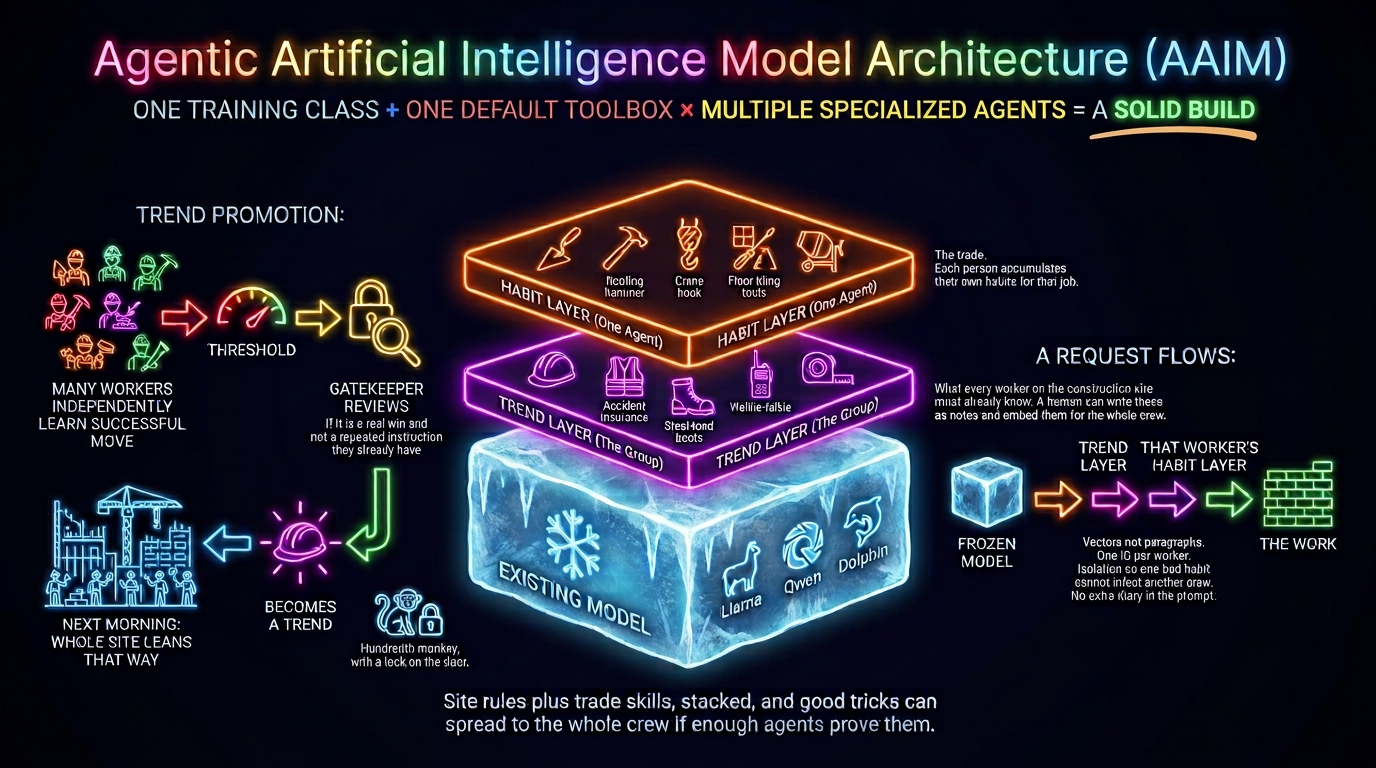
Add habit and trend layers to the model you already run.
Not a new AI. A clerk in front of the model you already run — local or commercial. Trend is the crew. Habit is one agent.
This is not another file
A habit layer and a trend layer are not extra markdown you dump into every prompt. They are a table of standing orders on an agent id or a crew id. A small meaning matcher (MiniLM) searches that table without sending the book to the big model. Only the cards that match this job ride along.
Skill files, project memory, SOUL.md, daily logs: keep using them as normal. They are still the right place for facts, tickets, and one-off context. AAIM is only for the things you are tired of saying again.
Write “put downloads here” once. The next download prompt attaches that card. A disk-space prompt does not. That works the first time, on Dolphin or on a paid API, because the worker still reads the matching line — and nothing else from the catalog.
The construction crew
Picture a job site. One set of physics. Two kinds of second nature.
Everyone wears a hard hat, has accident insurance, wears steel-toed shoes, carries a walkie-talkie, and knows a tape measure. You do not teach that as a novel to each hire every morning. That is the trend layer — group permission. A human can write those rules once and embed them for the whole crew.
Then the trades split. One agent lays brick. One roofs. One runs the crane. One tiles floors. One mixes concrete. Same site. Same safety. Different hands. That is the habit layer — user permission. The bricklayer should not reread the crane manual. The crane operator should not reread how to butter a brick.
A request on that site does not start with a speech. It flows: job → trend catalog → habit catalog → only the matching cards → whatever model you pointed at → the work.
Two permissions
Same kind of object — a standing-order table the clerk can search — two keys. Both layers are optional. You can run the model alone.
| Trend layer | Habit layer | |
|---|---|---|
| Permission | Group | User (one agent ID) |
| Who it is for | The crew. Site rules. | One seat. One trade. |
| Who can read it | Members of that group | Only that agent |
| Who can write it | A human, or a threshold plus a gatekeeper | That agent’s own good traces, or an explicit keep |
| Order at inference | Searched first, if present | Searched second, if present |
One loud agent cannot rewrite the species. A habit never becomes a trend just because it is popular with one ID. And a trend on Crew A does not leak into Crew B.
The workflow
Take the job
The clerk sees the user prompt only. The catalog stays on the shelf.
Search the trend catalog
Crew cards that match this job. Hard hats only if the job needs a hard hat.
Search that agent’s habit catalog
Meaning match, not just a tag word. “Grab this file” still finds the download folder.
Call the worker
Local or commercial. It only receives the job plus the matching cards. The rest of the table never ships.
Maybe write a habit
The same successful move, enough times (three-times-then-commit, or whatever you set), may update that agent’s habit layer only.
Maybe promote a trend
If enough of the crew independently produce the same winning trace, a gatekeeper reviews it. Real win? Not a duplicate instruction? Then — and only then — the trend layer updates. Next morning the whole site already leans that way.
Same idea, on a real agent crew
Swap hard hats for a shop of coding agents on one frozen Qwen. Same stack. Same permissions.
Trend layer — the shop. Never commit secrets. Run the formatter. Write a test before you touch prod. Page a human before a delete. A person can write those once. They become vectors on the group layer. Those lines come out of every agent’s skill file and morning prompt. The files can stay for facts and tickets. The repeated rules do not need a seat in the window anymore.
Habit layer — the seat. One agent lives in the design system. One knows the database schema. One reviews pull requests. One writes migrations. They do not reread each other’s trades every morning. They accumulate lean for the job they actually have.
A morning. A ticket arrives: “add a column, backfill it, don’t lock the table.” Flow: frozen Qwen → shop trend (no secrets, tests, don’t nuke prod) → the migration agent’s habits (how this schema likes to move) → the work. Short prompt. The map is the ticket. Driving is already there.
A win that spreads. That migration agent finds a safer backfill pattern. It works. It works again. Third time, it may commit to their habit layer. Two other agents in the same shop independently hit the same pattern. Threshold is, say, half the crew. A gatekeeper agent — or you — checks: is this actually safer? Do we already teach it? If yes, write it once into the trend layer. Tomorrow a new hire with a blank habit layer still does not lock the table. A stranger outside this shop never sees it.
That is the hundredth monkey, with a lock on the door. Enough of the crew prove the move. Someone still checks they washed a potato and not a rock. Then you stop repeating the instruction.
Build order
Habit table first
One agent id. Write the standing order once. Clerk attaches it only when the job matches. A second id does not have it.
Trend table second
Optional crew catalog in front. Human-seeded shop rules first.
Promotion last
Threshold, gatekeeper, then a trend write. Measure cheaper mornings. Then stop.
What we will not do
- Train a new foundation model.
- Write into the shared Llama / Qwen / Dolphin file.
- Paste a smarter diary into the prompt and call it a habit layer.
- Let one agent’s habit layer leak into another’s.
- Auto-promote a trend with no threshold and no gate.